Sunday, October 13, 2019

Villefranche-sur-mer 2019 - 13 Eating Out

Dear Friends,

After publishing my last post, I was afraid that I had left the impression that we never venture out for a meal.   What a mistake and lost opportunity that would be.  I would also be lying by omission.  So I hope this post will clear up any misconceptions.

Villefranche-sur-Mer has many great restaurants ranging from very casual to very fancy.  Our favorite restaurant in Villefranche and maybe in the world is Le Serre.  It does not have a website, but here is the link to Trip Advisor.  There are many reasons that we love it.  The owner, Sylvie, and the staff we see the most often, Marie, Beranise and Mikado are warm, welcoming, funny people who are great at their jobs.  We are always welcomed like old friends and treated like royalty.

The food is simple but great.  They have lots of different pizzas, most of which are named for various US states.  We cannot see any connection between a particular state and the pizza with the name of that state.  The salads are also great and can be a full meal.

Each day Sylvie plans a 19 euro three course meal.  Every night there are three potential entrées (in France an entrée is the first course as it should be since it means entrance or starter), three potential plats (main courses) and a dessert of the day.  Two of each are the same every night but one of the three changes each night.  The two constant entrées lately have been tomato mozzarella toasts and a niçoise salad.  Last night the third was a tarte fin tomate mozzerella (a tart with fine herbs,

tomato and mozzarella).  The tart was fantastic.  The third choice for a main course yesterday was a vol au vent de la mer.  I do not know how to exactly translate that but it is seafood en croute.  I did not have it so I do not know how it was.  The dessert of the day was a strawberry panna cotta which was great.  In addition to the pizzas and the prix fixe menu, there is a full menu of other items.

We always eat at Le Serre on our first night and our last night.  We also eat there from time to time during our stay.  Here we are sitting outside at Le Serre on the night we arrived in Villefranche, exhausted but happy.


Here are a couple of other pictures of the wonderful food at Le Serre.  

a salad


 a chicken brochette with a zucchini tarte


a beautifully decorated panna cotta 


When we eat out, it is often for lunch.  One of the first days we were here, we met a friend for lunch at Le Mayssa Beach restaurant (trip advisor here).  It was a beautiful day and the restaurant is on the second floor overlooking the water.  Two of us had the loup (usually translated as sea bass) grilled and presented whole but then expertly deboned by the server.


Jane had a crab meat, avocado and tomato salad.
Le Mayssa Beach is right on the waterfront in Villefranche so there is virtually no walking involved which is a problem with a several hour French lunch.  With the need for exercise in mind, we sometimes walk to Beaulieu or Saint Jean Cap Ferrat for lunch.

One day we walked to Beaulieu with the intention of going to a small restaurant we had eaten at before.  Unfortunately we arrived after they had closed for lunch.  We walked to a string of restaurants in the fancy marina and went to L'Atelier d'Emile.  


We ate outside on a beautiful day.  Rather than rewrite the review I wrote for Trip Advisor (here), I will just quote myself.

"My wife and I stopped at L'Atelier d'Emile on a Friday afternoon just before 2:00 pm without a reservation and a little late for lunch. Nevertheless we were immediately seated in a very comfortable outdoor area. 
We both ordered the plat du jour which was "Le Filet de Lieu Noir Roti au Beurre Blanc Boulgour aux Légumes". We were not familiar with the type of fish. The waiter described the dish as a white fish in beurre blanc sauce. The kind of fish is saithe which is also known as coalfish, coley, or Atlantic Pollack. Apparently it can also be cod. In any case it is a wonderful light white fish that is flaky with a great texture. The beurre blanc sauce was fantastic. It had a great flavor yet was very light. The bulgar wheat went perfectly with both the sauce and the fish. The vegetables were finely chopped but still crunchy. They provided a wonderful taste, color and texture to the dish. For dessert we split a "riz au lait de coco aux fruits frais". It was a rice pudding with a not too heavy or sweet milk/cream sauce with coconut and beautiful fresh strawberries, blueberries and raspberries. It was delicious. 
The price was very reasonable particularly for Beaulieu. For two plat du jour, two glasses of house wine, one dessert and two coffees, the total bill including tip was 57 euros."


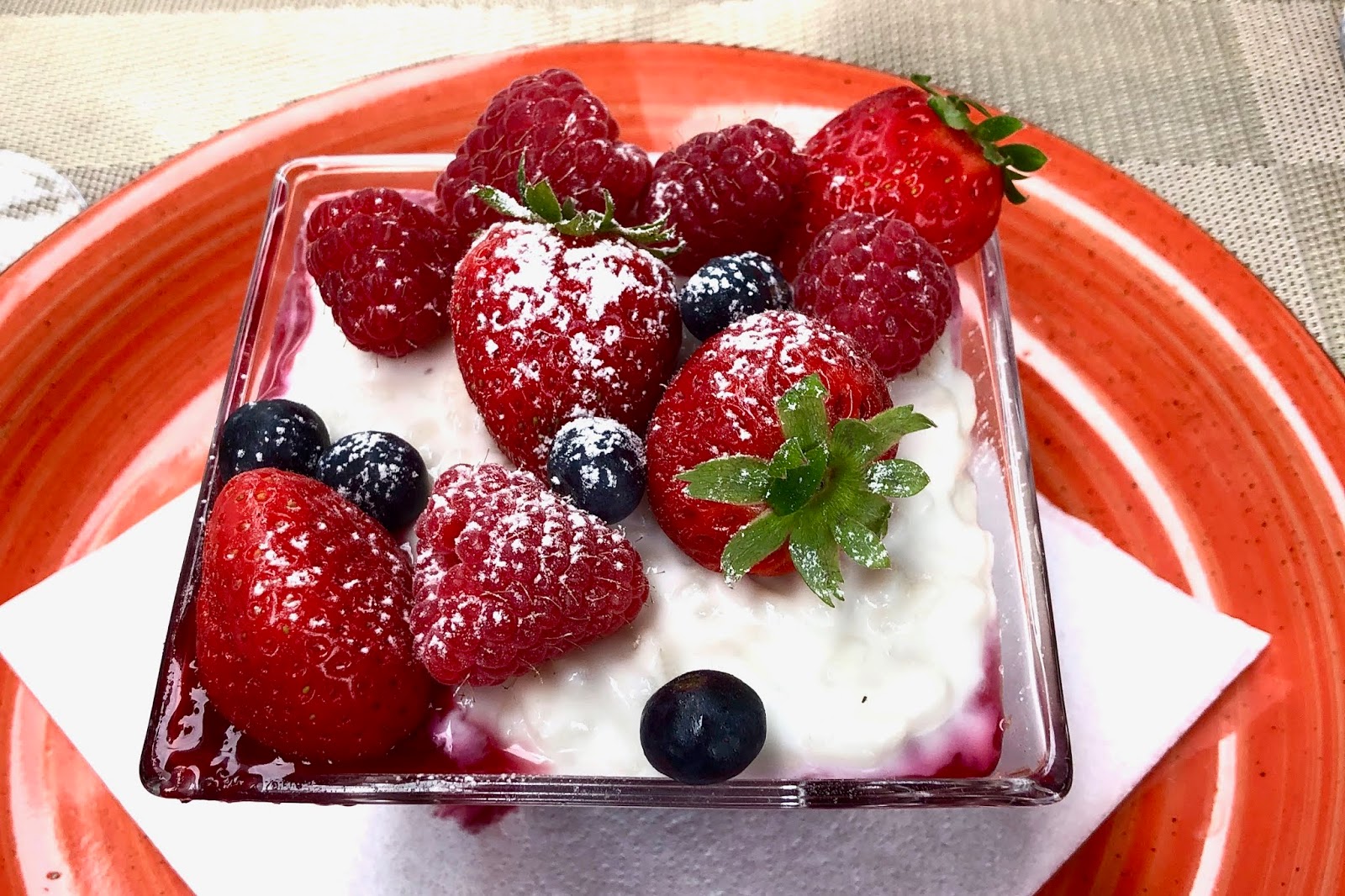

While this was a big lunch, please keep in mind that we walked about two miles each way for a total of 4 miles just for lunch.

Another day we walked to Saint Jean Cap Ferrat to a restaurant in the fancy marina there, Le Pacha du Sloop (Trip Advisor here).  This restaurant is just over 2 miles from our apartment so once again we walked over 4 miles in connection with this meal.  Actually we walked more than Google Maps would give us credit for since we took the scenic route past the house that used to belong to David Niven.  It is the only house that is actually right on the water without a public right of way between it and the water.  This picture was taken a couple of days earlier when we were out on a boat ride with the couple that we rent from, but that is a story for another time.


We had been to Le Sloop a couple of times before, and it is always good.  We splurged and each had the 27 euro prix fixe menu.  Sorry for the bad photo, but we didn't take it until the end of the meal.


For our entrées,  we split the marinated artichoke salad


and the green asparagus and basil salad.


We each then had the fresh grilled dorade (translated seabream by the restaurant).  It came grilled but whole.

We were left to do the deboning which did not look as great as the way a professional server does it.


The dessert du jour was a raspberry panna cotta with fresh raspberries on top.  It was great but a picture could not do it justice.  Jane did finish with a noisette which is technically a hazelnut but when ordered at coffee time is a small espresso with some warm milk.  The fashion and amount of the milk varies greatly depending on the place and who makes it.


While I was engrossed in writing this post, Jane reminded me that it was almost 2:00 pm and that we had not eaten lunch yet.  I remembered that we had no bread so we were forced to go out to lunch.  We just walked down to the row of restaurants along the quai and went to Trastevere (Trip Advisor here).  We had a simple but good lunch.  We split an Italian salad (lettuce, tomato, mozzarella, parma ham, melon and parmesan)


and a neapolitan pizza.


Unfortunately it took very few steps to get to Trastevere, but fortunately we took a nice walk along the beach this morning.  Such is life in Villefranche.

Thanks for reading and please comment,
The Unabashed Liberal


Villefranche-sur-mer 2019 - 12 Dinners at Home

Dear Friends,

We are back in Villefranche for a three week stay.  The weather has been perfect, and we are enjoying ourselves immensely.  We fill our days studying french, going for walks, lamenting the state of the world (particularly Trump and the Republicans) and shopping for our dinners.  We eat most dinners at home.  Virtually any dinner requires a stop at the butcher, the baker, the green grocer and a seller of wine.  The wine is the easiest since you can buy wine that this quite good very inexpensively almost anywhere.

We love to buy our wine at Chez Marie-Claire, our favorite boulangerie/pâtisserie.  Most boulangeries/patisseries sell bread and pastries and maybe a few extras like pieces of pizza, pre-made sandwiches and chocolates.  Marie-Claire does all of that plus eggs and wine.  Unfortunately Marie-Claire is getting older, probably well into her 80s.  She is open from 7:00 am until 12:30 pm and 4:30 pm to 7:00 pm most days.  In the summer she takes one day a week off and in the winter she takes two days off.    Normally that is not a problem because she coordinates with her arch rival, Patrice, who runs the other boulangerie/patisserie in the old town so that one of them is always open.  Unfortunately, in the winter there is one day when there is no boulangerie/patisserie open in the old town.  You can't really plan ahead for that problem because you need to eat the bread and pastries the day they are made or they are just not as good.

There is a boulangerie/patisserie just up the hill from the old town whose products are just fine.  But, it is modern and once you get your purchase your contact with a real person ends.  A machine tells you how much you owe, you put your money in one slot and your change comes out another slot.  It is incredibly impersonal so we only go there in a dire emergency, like needing a fruit tart for dessert when the Marie-Claire and Patrice are both closed.

The real problem is that these small shops are disappearing all across France.  As I said Marie-Claire is quite old with no obvious successor.  Bernard, the green grocer, is also quite old with no hope for a successor.  Pascal, the butcher, is not too old and from time to time his son helps out in the shop.  So there is hope there.  Patrice is not too old and wants to continue working but after many years of renting the same spot in the middle of the old town, her landlord is trying to throw her out and replace her with yet another real estate agency.  There are already way more real estate agencies in and around the old town than any other type of business.  We have joined with many locals in petitioning the mayor to intervene, but it is probably a lost cause.

On the bright side, there is a new focacceria in the old town.  He sells great Italian cheeses and salami along with a few pre-made Italian dishes and sandwiches.  He is young, and we try to frequent his store often in hopes that he succeeds.  Any conversation with him is a combination of Italian, English and French.  His English is worse than our french, and we speak no Italian.

The only issue with our method of provisioning for dinner is you really need to see what people have before deciding on your meal.  Bernard is the least reliable in that regard.  First, his hours are sometimes a little random and second, his inventory varies dramatically from day to day.

So here are some examples of our dinners at home so far this trip.  At this point, these will just be repeated.

In this meal, you see steak cooked perfectly on the gas grill on our balcony accompanied by a sauté of mushrooms, onion, leaks and garlic, a baked potato with crème frâiche and of course and steamed artichoke.


We do vary our steak meals. This one is accompanied with haricots verts and roasted baby tomatoes.


We don't just have steak.  On this day the butcher had some lamb chops so we got them.  Also there were no haricots verts so we got some flat Italian beans and big tomatoes instead of baby ones.


We don't just have red meat either.  Here we have a pork chop with flat Italian beans, red peppers and a sauté of carrots, mushrooms, onions, leaks and garlic.


We also have chicken.  Here we have a boneless skinless chicken breast grilled to perfection on our gas grill.  We put mustard on the top before cooking and then only cook from the other side.  Apparently the green grocer was out of green vegetables this day.


Some times we have more simple fare, but what could be better than an omelette with créme frâiche, sautéd ham and a fresh baguette with blueberry jam.


Sometimes we even eat vegetarian.  This simple pasta with tomato sauce and fresh burrata from the new focacceria with a sauté of zucchini, baby tomatoes and onions was even better than it looks.


You may have noticed the presence of a potato on the plate virtually every night.  Potatoes are plentiful here and very good.  We get one medium size baking potato for the two of us.  We then cut it in half lengthwise.  This approach permits us to maximize the amount crème frâiche per bite.

What I have not shown are the desserts.  We have not taken pictures of the desserts.  It would be too mean to show them to you.  Most of the time we split a pastry from Marie-Claire that looks particularly good that day - a religieuse (here), an eclair, a fresh fruit tart, etc.  

So we eat very well, but I have averaged over 11,000 steps and almost 28 flights of stairs a day since our arrival.

Thanks for reading and please comment,
The Unabashed Liberal


Sunday, August 11, 2019

Democratic Candidate for President 2020 - 3 How to win and who can win?

Dear Friends,

Now that we have a better idea about where all the Democratic candidates for President stand on the issues, I can say without any fear of contradiction that all of them are far better than President Trump.  I can also say that all of them that have any chance at being the nominee want racial and gender equity, fairer distribution of wealth and income, healthcare for all, education for all, housing for all, food for all, an immigration system that reflects our values as a country of immigrants, a living wage for all, etc.  I certainly have my favorites as a result of their positions on the issues, but I am focused on which one has the best chance of winning the election.  I would say electability, but I have already done a post on that subject so in this post I will refer to how to win and who can win.

I have been reading articles and studies on the 2016 voter turnout and related issues.  There are three that I would recommend to you.  A Pew Research Center article from May 2017 about black voter turnout falling here, an article from the Wisconsin State Journal in November 2017 about black voter turnout in Wisconsin here, and a study from the Center for American Progress (CAP) entitled "Voter Trends in 2016" from November 2017 here.  The report from the CAP is excellent but long and very detailed.  I will quote extensively from its conclusions below and then attempt to answer the how to win and who can win questions.

The CAP report focuses on four things:
Voter composition - the percentage of actual voters from various demographic groups
Turnout rates - the percentage of eligible voters in those demographic groups who are eligible to vote and did
Support rates - the support for the Democratic or Republican candidate from each of the demographic groups
Shifts - the shifts in these factors between the 2012 election and the 2016 election
The study considered 32 demographic groups
Racial - white, black, latino and asian/other
Age - 18-29, 30-44, 45-64, and 65+
Education  -  four year college degree and no four year college degree

As background here are some findings that are important as you consider the conclusions.
The voters in 2016 were
     73.7% white  down 0.3 points from 2012
     12% black down 1.1 points from 2012
     8.9% latino up 0.9 points from 2012
     5.5% asian/other up 0.5 points from 2012

White voter share dropped by only 0.3 points between 2016 and 2012 even though white share of eligible voters dropped by 1.7 points.  Black voter share dropped by 1 point even though black eligible voters rose 0.2 points because black turnout fell by more than 4 points (62.1% to 57.7%)

White non-college degree voter turnout was up 3 points while white college degree voter turnout was up only 2 points.

As we all know too well, Presidential elections are not decided by majority vote of the country but by state.  The CAP report had the following conclusions for the three rust belt states that were supposed to stop Trump but instead went for him - Michigan, Pennsylvania and Wisconsin.  Here are the conclusions:
Our estimates indicate that if black turnout [in Michigan] had remained at its 2012 level, Clinton would have carried the state. For that matter, she also would have carried the state if white non-college-educated turnout had remained at its 2012 level, instead of going up. And it would have probably been enough to flip the state if Latino turnout had remained stable across the two elections. 
Our estimates indicate that changes in black turnout in Pennsylvania had little effect on the election outcome; had black turnout remained at its 2012 level, it would have done little to overcome Clinton’s 0.7-point deficit in the state. However, our estimates show that if white non-college-educated turnout had remained at its 2012 level, instead of increasing significantly as it did, Clinton would have been able to carry the state. 
In contrast to Pennsylvania, here [in Wisconsin] we found that black turnout had a significant effect on the election outcome; had black turnout remained at its 2012 level, instead of dropping as it did, Clinton would have erased her 0.8 point deficit and won the state, albeit narrowly. None of the other changes in turnout from 2012 to 2016 had much of an effect on the outcome, according to our analysis.  
This [Michigan, Pennsylvania and Wisconsin] reflects the ongoing decline in the white non-college-educated share of eligible voters, which could be only partially mitigated by increases in white non-college-educated turnout. However, it is important to stress that these increases in white non-college-educated turnout were otherwise important: In two of the three states—Michigan and Pennsylvania—Clinton would have been able to carry the states if this group’s turnout had remained at 2012 levels.
As you can see from the above, turnout in two groups seemed to be critical - white non-college and black voters.  The report goes on to discuss the three states that Obama flipped in 2012, but Clinton did not - Florida, Iowa and Ohio as well as North Carolina which Obama did not win.
In terms of shifts from 2012, the most interesting change [in Florida] was that the white non-college-educated share of voters went down so little—a mere 0.3 points—despite that group’s share of eligible voters falling by almost 3 points. This was due to a nearly 7-point increase in white non-college-educated voter turnout. Without that turnout spike, Trump might not have carried the state.  
The biggest change in the structure of the electorate [in Iowa] compared to 2012 was a 1-point decline in the share of white non-college-educated voters. Turnout was down for all racial groups except Latinos, whose turnout increased by 6 points. However, our estimates indicate that turnout shifts had little to do with Clinton’s 9-point deficit in the state: If Iowa turnout patterns had remained the same as they were in 2012, it would have barely moved the needle. 
White non-college-educated voters [in Ohio] were down by a modest 0.6 points from 2012, while white college voters increased their vote share by 2 points and black voters declined by close to the same amount. The latter was tied to a sharp drop in black turnout in the state—down 10 points from 73 percent to 63 percent. This by itself dropped Clinton’s margin in the state by almost 2 points. But because she lost Ohio by more than 8 points, this was hardly the decisive factor in her loss.
Another key loss for Clinton was North Carolina, although this was a state that Obama also did not carry in 2012. Here the white share of voters actually went up—increasing by 2 points to 72 percent—and, very unusually, this included a 1-point increase in the share of white non-college-educated voters. Black voters, on the other hand, declined by 3 points as a share of voters, reflecting their 9-point fall in turnout, from 75 percent in 2012 to 66 percent in 2016. By itself, this decline in black turnout did not hand the state to Trump because, even if 2012 levels had been maintained, Clinton would still have lost narrowly. But the race in that state would have been a great deal closer. 
In discussing the national results of who voters supported in the 2012 and 2016 election, the CAP report concluded
Reflecting the fairly large change among non-college-educated white voters, plus their very large size as a group, this was the support shift that had the largest effect on Clinton’s fortunes. If Clinton had been able to replicate Obama’s level of support among non-college-educated white voters, she would have carried the popular vote by 4.4 points instead of the 2.1-point advantage she had last November. Interestingly, the second most important shift holding down Clinton’s support was the decline in vote margin among black voters. That shift took 0.9 points off of her popular vote margin, which is actually slightly more than she lost from the decline in black turnout. 
All of these conclusions would tend to support the need to get some of the non-college educated whites to vote for the Democratic candidate.  In the media these days these people are often referred to as Trump voters who could be won back to the Democratic Party.  As it turns out just because white non-college educated voters did not vote for Clinton does not mean that they voted for Trump as the following from the CAP report indicates
A final note here: In the discussion above and subsequently in our discussion of particular states, we concentrate on margin shifts relative to 2012 because these directly determined the relative electoral fortunes of Trump and Clinton. However, in this election it was typically not the case that margin shifts for a given group relative to 2012 were composed of decreases in support for one major party and equivalent increases in support for the other major party. There were usually some increases in third-party voting as well. 
For example, among white non-college-educated voters in 2016, there was a 5-point decrease in support for Clinton relative to Obama, a 1-point increase in support for Trump relative to Romney, and a 4-point increase in third-party voting. Among white college-educated voters there was a 6-point decrease in support for Trump relative to Romney, a 1-point increase in support for Clinton relative to Obama, and a 5-point increase in third-party voting. Finally, among black voters there was a 5-point decrease in support for Clinton, a 3-point increase in support for Trump, and a 3-point increase in third-party voting. Thus, even though the changes in margin between Democrats and Republicans determined the election outcomes, it should be kept in mind that increased third-party voting was frequently implicated in these margin changes.
75% of the white non-college educated voters who voted for Obama but not for Clinton went to a third party and only 1/6th of the white college educated voters who voted for Romney but not Trump voted for Clinton.  Why did so many people object to her?  The report reaches no conclusion on that point, but I would speculate it was that she was not a good candidate.  She had lots of baggage and was unable to generate enthusiasm except in those who really wanted a woman president.

So how do the Democrats win?

As I have said before turnout is the key as it always is for the Democrats.  The CAP report only focuses on the voters in 2012 and 2016 so none of its conclusions address the fact that the United States has terrible voter participation.  We are 35th among developed nations.  In 2016 only 59% of eligible voters turnout.  In 2008 62% turned out to elect the first black president.  Just those 3 points represent 7 million voters.  If all eligible voters voted at the same rate as the older voters, there would have been over 25,000,000 more votes cast in 2016 than there actually were.  Clinton would have won in a landslide.

According to the Pew report cited above, older voters (boomers and older) vote very consistently at close to 70% but younger voters particularly millennials (20-35) are inconsistent and lower.  In 2016 50.8% of them voted, up 4.4 points from 2012.  Black millennials were down 4.4 points while white millennials were up 2.8 points and hispanics up 3.8 points.

The Democrats can win by getting the millennials out to vote.  They can only achieve this result by putting forward a candidate who generates enthusiasm among that cohort.  The older people will vote because that is what they do, and they will stay with the Democrats (not vote for a third party candidate) if we have a candidate that has little baggage and generates enthusiasm.

Michael Moore has suggested that in addition to a candidate that generates enthusiasm, we should be sure that there are initiatives on the ballot that generate enthusiasm especially among young voters, eg, marijuana and anti-gerrymandering.  I think those are good ideas.  In fact anything to generate enthusiasm.

So which Democrat has best chance to win?

Of course this question is more difficult to answer.  It is clear to me that older white guys are not the way to go.  I include in this group - Biden, Hickenlooper, Inslee, and Steyer.  Bernie may be an exception.  A second group is middle aged middle of the roaders.  I include in this group Bennet, Bullock, de Blasio, Delaney, Klobuchar, and Gillibrand.  I would also eliminate Gabbard, Ryan, Williamson and Yang because they do not stand a chance.   I would also eliminate O'Rourke because if I want a young white male, it would be Buttigieg.

That leaves (in alphabetical order) Booker, Buttigieg, Castro, Harris, Sanders, and Warren.  Each of these candidates could certainly generate enthusiasm.  Some of them have more baggage than others, but none of them has the baggage that Clinton did.  Polling data at any point in the race is interesting but hardly determinative.  Obviously all the polls got the last election very wrong.  I really doubt that the polling techniques have figured out how to conduct a truly representative poll in today's world where people don't answer their phones if they don't recognize the caller.

Here are the results from Real Clear Politics for these candidates from May 30 and August 6
                  May 30     Aug 6
Booker          2.2             2
Buttigieg       6                6.5
Castro           1.2             0.8
Harris           7.4             8.3
Sanders        16.6          16.5
Warren          9.8           18.3
Just for reference, Biden was at 34.8% on May 30 and on August 6 he was at 30.8%.

So my conclusion is that Elizabeth Warren is the best candidate to win the general election.  The more people get to know her the more they like her.  She generates enthusiasm and has little or no baggage.

Thanks for reading and please comment,
The Unabashed Liberal